

































ldable LED Advertising Screens Are Changing How European Music Festivals Handle Sponsorshi
Nobody Warned the Sponsors It Would Look That Good
There is a particular moment that happens on festival site builds that anyone who has worked enough of them will recognise. It is the moment a sponsor's brand activation team arrives at their allocated zone on the morning of day one, sees what has been built overnight, and goes quiet for a second. Usually they go quiet because something has gone wrong.
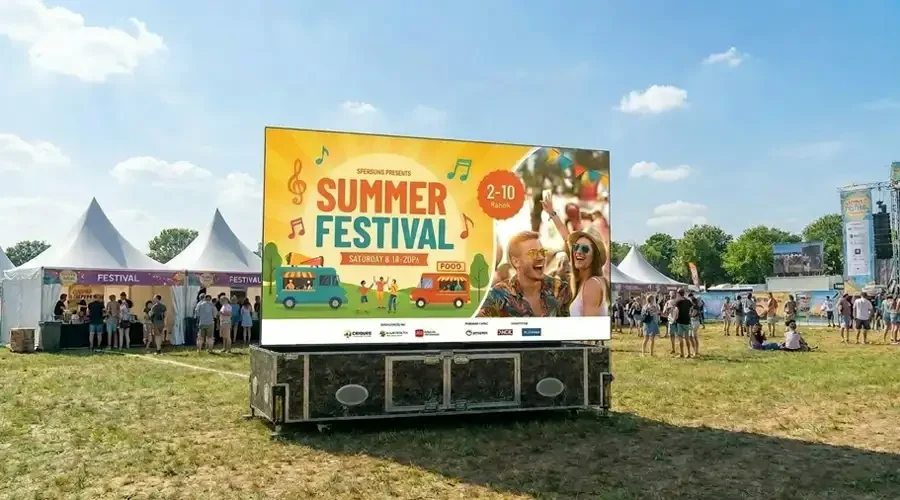
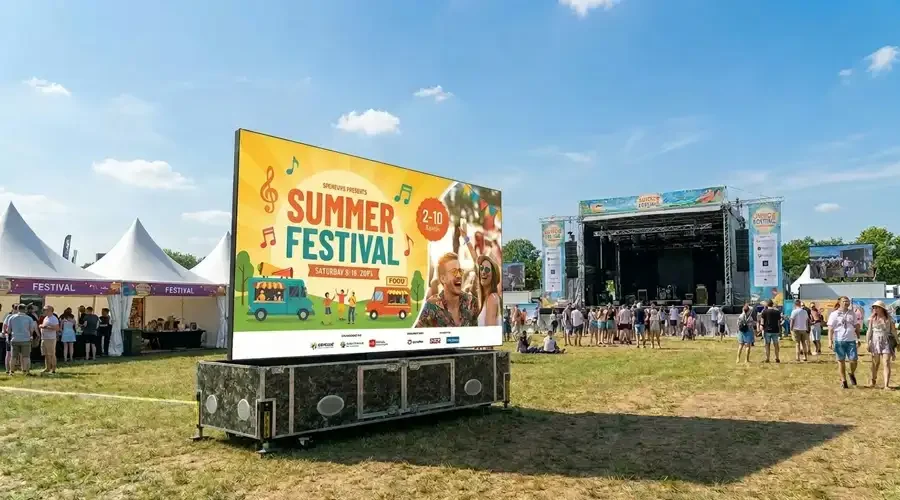
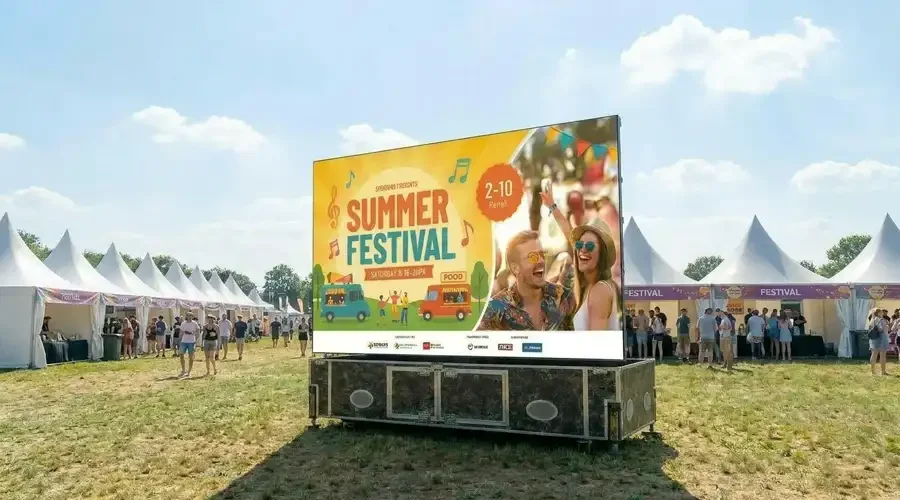
At a major outdoor music festival in the Netherlands last summer, the silence was different. The brand activation manager for one of the event's principal sponsors — a European sportswear label — had arrived expecting to see the same kind of branded gazebo-plus-banner arrangement their team had used at every festival for the previous four years. What they found instead was a fully deployed foldable outdoor LED advertising screen, standing over four metres tall, running their campaign content in full daylight-readable brightness, in the middle of a field, with no fixed infrastructure, no external power cables running across the ground, and no structural support that required a building permit or a ground anchor approval from the site landowner.
They stood and looked at it for a moment. Then the brand manager took out her phone and called her head office.
That call led directly to the same screen format being deployed across two further festival sites in Germany and Belgium in the same summer season. Which is, more or less, how things tend to spread when something genuinely works in the event industry.
The Festival Advertising Problem That Nobody Had Properly Solved
If you have ever tried to build a meaningful brand presence at a large-scale outdoor music festival, you will understand the structural problem that has existed in the space for a long time.
Festivals are temporary. The sites are temporary. The audiences are dense and fast-moving. The weather in northern and central Europe is hostile to anything that cannot be quickly assembled, quickly dismantled, and transported in a vehicle that fits into a festival backstage compound. And the commercial pressure on festival brand activation teams has increased significantly over the past decade, as sponsors have shifted from simply wanting their logo visible to demanding activations that generate social media content — which means visual impact is now the primary deliverable, not just presence.
Static banners and printed hoardings have a visibility ceiling. They cannot run video content. They cannot change messaging between the Friday and Sunday programmes. They cannot respond to the headliner lineup, the weather, or the moment a brand wants to push a specific product off the back of a set that just happened on the main stage. In a media environment where timeliness and visual impact are everything, static print formats at festivals are doing a job that the audience has already moved past.
Large-format traditional LED screens exist, but they bring a different set of problems to a festival environment. Fixed-structure outdoor LED installations require ground anchoring, structural engineering sign-off, significant assembly labour, and the kind of logistical footprint that most festival sites cannot accommodate in brand activation zones that are simultaneously handling catering, artist meet-and-greet infrastructure, and crowd flow management. The build windows at most European festivals — typically 24 to 48 hours before gates open — do not allow for the installation timelines that conventional large-format LED structures require.
The Reiss foldable outdoor LED advertising screen solved both sides of this problem simultaneously, which is precisely why it spread through the European festival circuit as quickly as it did.
What a Foldable LED Screen Actually Means in a Festival Context
The term foldable gets used loosely in the LED display industry, and it is worth being specific about what it means in a format that is designed for outdoor festival environments rather than indoor exhibition use.
The Reiss foldable outdoor LED screen used across these three festival deployments is an integrated display and structural system that ships flat-packed in standard flight cases sized for standard vehicle and trailer loading. On site, the entire display — screen panels, structural support frame, and power distribution system — assembles and deploys without any specialised tools, fixed ground infrastructure, or crane equipment. The assembly process for the primary display units at the Netherlands festival was completed by a two-person crew in under 90 minutes per unit, working without any equipment beyond what arrived in the flight cases.
The display face for the primary brand activation format used across these festivals was 6 metres wide by 3.5 metres high — large enough to be the dominant visual element in a festival brand activation zone, visible across a significant portion of the site, and capable of running the kind of large-format video and motion content that generates genuine audience engagement and social media filming.
Pixel pitch for the outdoor festival application was P5 — a specification chosen for the balance it strikes between image quality and module robustness in a format that is being assembled, disassembled, transported, and reassembled across multiple festival sites in a single season. At the viewing distances typical of festival brand activation zones — predominantly 5 to 25 metres — P5 delivers sharp, vivid image reproduction for the video content, brand animation, and live social media feed integrations that the sponsor teams were running on these screens.
Brightness was specified at 6,000 nits. European summer festival environments are less extreme than tropical climates in terms of peak ambient light intensity, but northern European summer days are long, and direct solar angles during afternoon peak audience hours can significantly reduce the apparent contrast of displays that are not specified for outdoor daylight conditions. At 6,000 nits, the Reiss foldable screens maintained full content legibility and visual impact across all daylight and evening operating conditions encountered across the three festival sites — from a midday summer field in Germany to an overcast Belgian evening where the screen's brightness made it the single brightest visual element in the entire activation zone.
Three Festivals, Three Different Commercial Applications
What made these deployments commercially interesting was not that all three sponsors used the foldable LED format the same way. They didn't. And the flexibility of the format to support fundamentally different commercial objectives at three different events is arguably the clearest evidence of how versatile it actually is.
At the Netherlands festival, the sportswear brand used the screen as a pure brand broadcasting surface — running a mix of campaign content, athlete footage, and product launch material across the full festival weekend, with content scheduled to align with the programming on adjacent stages. The screen ran continuously from 11am to midnight across all three festival days, accumulating audience exposure numbers that the brand's own event team described as the highest per-activation-unit figures they had recorded at any European festival in the previous three years.
At the German festival, the approach was entirely different. A streaming platform used the foldable LED screen not as a content broadcast surface but as an interactive audience engagement tool — running a live social media wall that aggregated user-generated content posted from the festival site, displaying audience posts, photographs, and reactions on the large-format screen in near-real-time. The screen became part of the audience experience rather than a surface audiences observed passively. The platform's activation generated over 45,000 individual user-generated social posts tagged to the activation over the three-day event.
At the Belgian festival, an automotive sponsor used two foldable LED screens in a paired configuration flanking a vehicle showcase zone, running coordinated content across both screens simultaneously to create a wide-format immersive brand environment around the physical product display. The visual coherence of the screen content with the physical activation space — achievable because the screens could be positioned, angled, and configured freely without any structural constraints — produced an activation environment that felt architecturally designed rather than provisionally assembled in a field.
The Logistics That Actually Make This Work
Festival event production professionals are, as a group, intensely practical people. They have seen enough technology that looks impressive in a showroom and falls apart on site to be justifiably sceptical of anything that promises to simplify what is already a compressed and high-pressure build process.
The logistics of the Reiss foldable outdoor LED system across these three festival deployments were as follows. All units shipped from the European distribution point to each festival site in standard panel vans — no specialist transport required. All assembly and deployment was completed by the event production crew without any Reiss technical personnel on site after the first festival deployment, where an initial handover and crew training was completed in one morning. Disassembly and repack at the end of each festival was completed within the standard breakdown window — no units requiring extended site time or specialist retrieval.
Across all three festivals, there were zero display failures during live operation. The IP65-rated cabinet construction performed without issue through one significant overnight rain event at the German site and the typically changeable Belgian festival weather across the full three-day run.
The content management system was operated remotely by each sponsor's own brand activation team — in each case using the platform's web interface with no technical training beyond a 30-minute onboarding session. Content updates, scheduling changes, and real-time messaging adjustments were made by the sponsor teams independently throughout each festival.
Technical Specifications
| Specification | Detail |
|---|---|
| Product | Reiss Foldable Outdoor LED Advertising Screen |
| Pixel Pitch | P5mm |
| Primary Display Size | 6m × 3.5m |
| Peak Brightness | 6,000 nits |
| Refresh Rate | 3,840 Hz |
| Weatherproof Rating | IP65 |
| Assembly Crew Required | 2 persons |
| Assembly Time | Under 90 minutes per unit |
| Transport Format | Standard flight cases, panel van compatible |
| Power Supply | Standard single-phase, no external generator required |
| Operating Temperature | -20°C to +55°C |
| Content Management | Remote web-based platform |
| Deployment Sites | Netherlands, Germany, Belgium |
What Sponsors Actually Said
Direct quotes from event sponsors tend not to appear in case studies like this, for obvious reasons relating to corporate approval processes. But the commercial behaviour of the three sponsors involved in these deployments tells the story more clearly than any quote would.
All three sponsors renewed or expanded their use of the foldable LED format for the following festival season. Two of the three added additional units to their activation footprint. One sponsor's European marketing team circulated an internal briefing document recommending the foldable outdoor LED format as the default outdoor display specification for all future European festival sponsorship activations — replacing the combination of static banners, printed hoardings, and small-format promotional screens that had been the standard for their event marketing programme for the previous six years.
That internal recommendation is, in the event sponsorship world, the functional equivalent of a five-star review. It means the format worked, the logistics held, and the results justified the cost. In an industry where the standard answer to "will this work at a festival?" is "it depends," that kind of institutional endorsement does not happen unless the reality matched the promise.
Where the European Festival LED Market Is Now
The European outdoor music festival industry is large, commercially sophisticated, and increasingly competitive for sponsor spending. The major festivals — in the UK, Germany, the Netherlands, Belgium, France, Scandinavia, and across the rest of the continent — collectively attract tens of millions of attendees annually, and the brand activation spend attached to this audience is substantial.
The format shift currently underway in European festival brand activation — away from static print toward mobile, deployable digital display — is being driven by exactly the commercial logic that these three deployments illustrate. Sponsors want content flexibility, visual impact, social media amplification value, and the ability to activate quickly and efficiently within the compressed logistics timelines of the festival production world.
Foldable outdoor LED screens are the format that answers all of those requirements simultaneously. The technology is mature. The logistics are proven. The commercial results, in the festival environments where this format has been deployed, are demonstrably strong.
The question for European festival brand activation teams is no longer whether this format delivers. The question is which deployments across the 2025 and 2026 European festival seasons will define what best practice in the space looks like — and which brands will be first to establish the visual identity advantage that comes with being the first premium LED activation in a festival market where the format is still establishing itself.
Frequently Asked Questions — Foldable Outdoor LED Screens for Events and Festivals
How quickly can a foldable outdoor LED screen be assembled at a festival site?
The Reiss foldable outdoor LED screen in the primary festival configuration — 6m × 3.5m — assembles and deploys in under 90 minutes with a two-person crew, using no specialist tools or equipment beyond the components supplied with the system. This makes it fully compatible with the 24 to 48-hour build windows typical of major European festival productions.
Can a foldable LED screen operate outdoors through rain and wind?
Yes. The Reiss foldable outdoor LED screen carries an IP65 weatherproof rating and is designed for continuous outdoor operation across the full range of European summer weather conditions, including rain, wind, and temperature variation. All three festival deployments included operation through rain events without any impact on display performance.
What content formats can be displayed on a foldable outdoor LED screen at a festival?
The system supports full-motion video, static graphic content, live social media feed integration, real-time data displays, and simultaneous multi-zone content. Content is managed through a remote web-based platform that can be operated by non-technical brand activation staff without specialist training.
Does the screen require an external power generator?
No. The Reiss foldable outdoor LED screen operates from a standard single-phase power supply, compatible with the standard temporary power infrastructure present at all major European festival sites. External generator equipment is not required for standard deployment configurations.
Can multiple foldable LED screens be run simultaneously with synchronised content?
Yes. Multiple units can be networked to run synchronised content across paired or grouped configurations, as demonstrated in the Belgian festival automotive activation where two screens were run in a coordinated widescreen format around a physical product showcase zone.