



































Highway LED Billboard Upgrades That Actually Deliver ROI — A U.S. Infrastructure Case Study
The Billboard That Nobody Was Looking At
There is a stretch of interstate highway in the southern United States where traffic volume exceeds 85,000 vehicles per day. For years, a static printed billboard stood at one of its highest-visibility interchange positions — changed manually every four to six weeks, weathered by sun and rain, and generating a fixed, predictable, and frankly underwhelming return for the outdoor advertising company that owned the structure.
The problem was not the location. The location was excellent. The problem was the medium. A static billboard in a high-traffic corridor can only sell one message to one advertiser at a time. It cannot respond to the time of day, the day of the week, or the season. It cannot be updated when an advertiser changes a promotion overnight. And it certainly cannot compete visually with the digital environment that modern highway audiences have come to expect.
The decision to replace it — and eleven other static structures across the same interstate corridor — with a full Reiss high-brightness outdoor LED billboard system was not driven by aesthetics. It was driven by a straightforward commercial calculation. And the results validated that calculation in the first operating quarter.

What the Operator Actually Needed
Before any technical specification was discussed, the conversation started with a commercial one. The operator's primary requirement was simple: sell more advertising inventory, at higher rates, to more advertisers simultaneously, without increasing structural or operational overhead across the corridor.
This translated into three non-negotiable technical requirements. First, the display had to be bright enough to be fully legible — not just visible, but actually readable and commercially impactful — at highway driving speeds, across all daylight conditions including direct midday sun in a southern climate where summer temperatures regularly exceed 38°C and ambient light intensity is extreme. Second, the system had to be reliable enough to operate without intervention across a distributed network of twelve structures spread along an 80-mile corridor, where on-site maintenance visits represent a significant operational cost. Third, the content management platform had to support multi-advertiser slot rotation, automated scheduling, and remote content updates — the commercial infrastructure that makes a digital billboard network financially viable.
A fourth consideration, specific to the U.S. regulatory environment, shaped the structural and technical approach from the outset. Outdoor digital billboard installations on interstate highways in the United States are subject to the Highway Beautification Act and state-level Department of Transportation regulations that govern brightness limits, content change frequency, and structural specifications. Any system that could not be configured to operate within these regulatory parameters was not a viable option regardless of its technical performance.
Why P10 at 10,000 Nits
Pixel pitch and brightness selection for highway billboard applications are driven by physics, not preference.
At highway driving speeds of 65 to 75 miles per hour, a driver's effective viewing window for a roadside billboard — the period during which the display is within readable sightline — is approximately 5 to 7 seconds. Within that window, the content must register immediately, communicate its message completely, and leave a recall impression strong enough to drive the advertiser's intended response. This is not a context where subtle imagery or fine typographic detail performs. It is a context where brightness, contrast, and visual simplicity determine whether a message lands or disappears into the visual noise of the highway environment.
The P10 pixel pitch delivers the resolution appropriate for the viewing distances involved — typically 50 to 150 metres from the display face to the viewer's position in moving traffic. At these distances, P10 produces clean, sharp content reproduction for the text sizes, logo formats, and image compositions that highway advertising uses. Going to a finer pixel pitch at this application would add cost and complexity without delivering any visible benefit to a viewer travelling at highway speed.
The brightness specification of up to 10,000 nits was selected based on measured ambient light intensity data from the installation corridor. Southern interstate environments in full summer daylight are among the most demanding ambient light conditions an outdoor display will encounter anywhere. At 10,000 nits peak output, the Reiss display maintains full content legibility and color saturation under these conditions without exception. The automatic brightness control system then scales output down progressively through the evening and overnight hours — reducing power consumption significantly during low-ambient-light periods while maintaining visibility standards appropriate to each time of day.
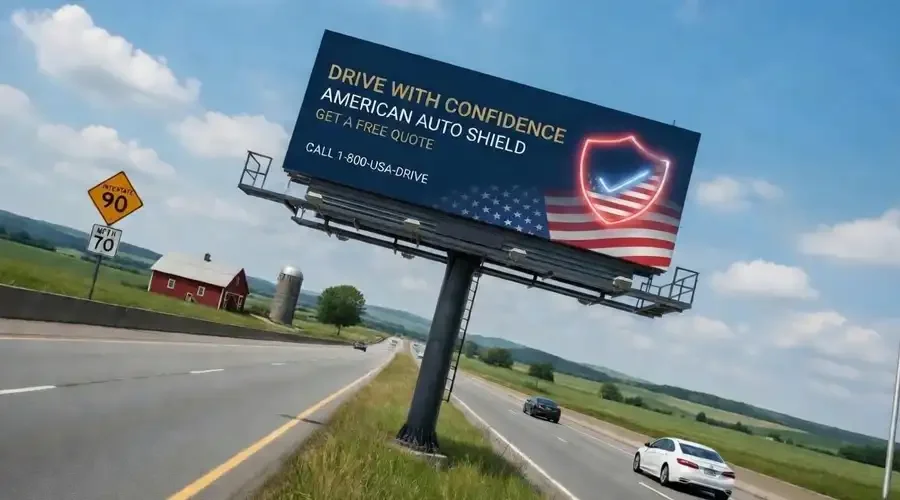
The Regulatory Dimension — Building a Compliant Digital Billboard Network
Operating digital billboards on U.S. interstate highways requires working within a regulatory framework that many international LED display suppliers underestimate. State DOT regulations in most U.S. states impose specific brightness limits for digital billboards — typically expressed as a maximum luminance level measured at a defined distance from the display face — and require that brightness levels be automatically controlled to remain within these limits across all operating conditions.
Content change frequency regulations are equally specific. Most states permit content changes no more frequently than once every 6 to 8 seconds on interstate digital billboards, with instantaneous transitions (hard cuts) rather than animated transitions required in many jurisdictions. Some states impose additional restrictions on the use of animation, video content, and full-motion imagery on highway billboards entirely.
The Reiss outdoor LED system was configured from the outset to operate within the applicable state DOT brightness standards, with the automatic brightness control system programmed to hard-limit maximum output to the regulatory threshold at all times. The content management platform was configured to enforce the 8-second minimum display duration per advertiser slot and hard-cut transition format required by the state regulations applicable to this corridor — ensuring that the operator's network remained in full compliance across all twelve structures without requiring manual monitoring or intervention.
This regulatory compliance capability — the ability to configure the system to operate within the specific legal parameters of the jurisdiction — was a material factor in the operator's decision to select Reiss for this project.
Installation Across a Distributed 80-Mile Corridor
Installing twelve LED billboard structures across an 80-mile interstate corridor presents logistical challenges that a single-site installation does not. Structures are geographically dispersed, access conditions vary, and minimizing traffic disruption during roadside installation work is both a safety and a regulatory requirement in most U.S. states.
The Reiss installation approach for this project used pre-assembled modular cabinet sections that were fabricated and tested at the operator's facility before being transported to each site for final structural mounting. This approach reduced on-site installation time at each structure to less than one working day, minimizing roadside work exposure and traffic management requirements at each location.
Each billboard structure was connected to the central content management platform via cellular network connectivity, eliminating the need for dedicated data infrastructure across the corridor and enabling full remote content management, scheduling, and diagnostics from the operator's central office. The remote monitoring system provides real-time operational status for all twelve structures, with automated fault alerts that notify the operations team immediately if any panel or system component requires attention.
Technical Specifications
| Specification | Detail |
|---|---|
| Product | Reiss Outdoor Highway LED Billboard Display |
| Pixel Pitch | P10mm |
| Standard Display Size | 14m × 4.8m per structure |
| Total Structures | 12 across 80-mile corridor |
| Brightness Output | Up to 10,000 nits |
| Auto Brightness Control | Yes — ambient sensor, DOT compliant |
| Refresh Rate | 3,840 Hz |
| Weatherproof Rating | IP65 |
| Operating Temperature | -30°C to +65°C |
| Cabinet Material | Aluminum alloy, corrosion-resistant |
| Connectivity | 4G/5G cellular remote management |
| Content Zones | Multi-advertiser slot rotation |
| Regulatory Compliance | State DOT brightness and content standards |
| Installation Location | Southern United States, Interstate Corridor |
What Changed After the First Quarter
The commercial results in the first operating quarter after the network went live were straightforward. The operator moved from a single-advertiser static inventory model to a rotating multi-advertiser digital slot model across all twelve structures. Where each structure previously generated revenue from one advertiser per four-to-six-week cycle, the digital system enabled six to eight advertiser slots per structure on rotation — with slot pricing reflecting the premium visibility and immediacy of the digital format.
Revenue per structure increased by more than 300% in the first quarter of digital operation compared to the equivalent period in the previous year under the static system. Advertiser demand for inventory on the corridor increased significantly following the transition — driven partly by the ability to offer short-notice campaign activations, time-of-day specific scheduling, and rapid creative updates that the static format could never provide.
Operational costs per structure decreased. Remote content management eliminated the recurring cost of physical creative production and manual installation for each advertiser cycle. Maintenance requirements across the first operating year were minimal, with the remote monitoring system identifying and resolving minor operational issues before they required on-site intervention.

What This Project Demonstrates About the U.S. Highway LED Market
The U.S. outdoor advertising market is in the middle of a structural transition from static to digital that has been accelerating for a decade and shows no sign of slowing. The commercial logic is too compelling for operators to ignore — and the technology has matured to the point where the reliability, regulatory compliance capability, and total cost of ownership of a well-specified LED billboard system makes the investment case straightforward for any operator with high-traffic inventory.
What this project demonstrates specifically is that the transition delivers the greatest commercial return when the technical specification is matched precisely to the operational environment. Brightness, pixel pitch, regulatory compliance capability, and remote management infrastructure are not optional features in a highway billboard deployment. They are the foundation of the commercial model. Getting them right from the outset determines whether the investment performs.
Frequently Asked Questions — U.S. Highway LED Billboard Displays
What brightness level is required for an outdoor LED billboard to be visible on a U.S. highway in direct sunlight?
A minimum of 7,500 nits is recommended for southern U.S. highway environments with high ambient light intensity. Reiss outdoor highway LED displays are available with brightness output up to 10,000 nits, with automatic brightness control that scales output to regulatory limits during low-light periods.
What U.S. regulations apply to digital billboard installations on interstate highways?
Digital billboards on U.S. interstates are regulated under the Highway Beautification Act at the federal level, and by individual state Department of Transportation rules that govern brightness limits, minimum content display duration, transition types, and animation restrictions. Reiss systems can be configured to comply with the specific regulatory requirements of any U.S. state jurisdiction.
What pixel pitch is right for a highway billboard LED display?
For standard highway billboard applications at viewing distances of 50 to 150 metres, P8 to P10 is the appropriate pixel pitch range. P10 is the most widely specified configuration for large-format interstate billboard installations, delivering the right resolution for highway viewing conditions at an optimized cost and power efficiency.
How is content managed across a network of multiple billboard structures?
Reiss outdoor LED billboard systems connect to a centralized content management platform via cellular or broadband network connectivity. Operators can schedule, update, and rotate content across all structures in a network simultaneously from a single interface, with full advertiser slot management, scheduling automation, and real-time operational monitoring.
What maintenance is required for a highway LED billboard?
Reiss outdoor LED billboard cabinets are designed for minimal maintenance requirements with front-service access and remote diagnostic capability. Under normal operating conditions, scheduled on-site maintenance is typically required no more than once or twice per year, with the remote monitoring system handling day-to-day operational management and fault detection.