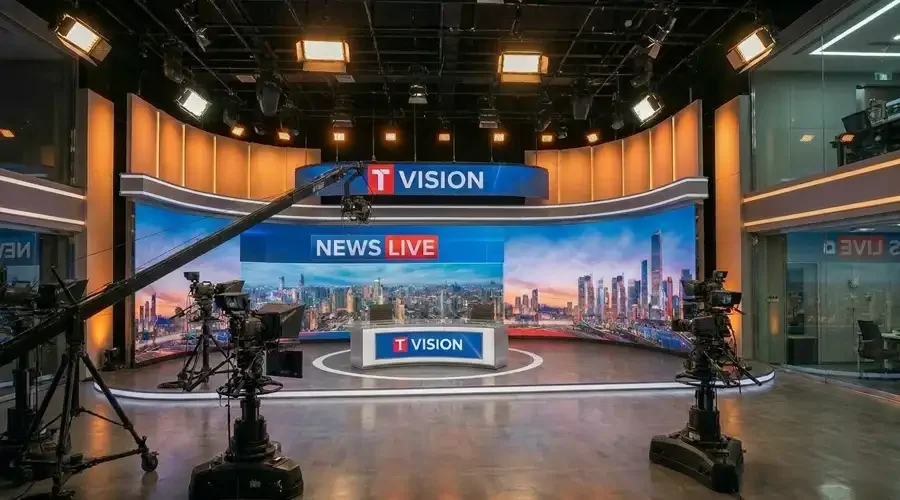



































Can a LED Screen Be Curved
Curved LED screens are no longer a futuristic concept reserved for exhibitions or landmark architecture. They are already reshaping how visual content is delivered in retail spaces, city centers, transportation hubs, entertainment venues, and corporate environments. The ability of an LED screen to bend, wrap, or form complex shapes has expanded the boundaries of digital display design, making curved LED technology one of the most discussed developments in modern visual communication.
At its core, the question is simple: can a LED screen be curved?
The answer is yes—but the reasoning, technology, applications, and limitations behind that answer deserve a detailed explanation.
What Defines a Curved LED Screen?
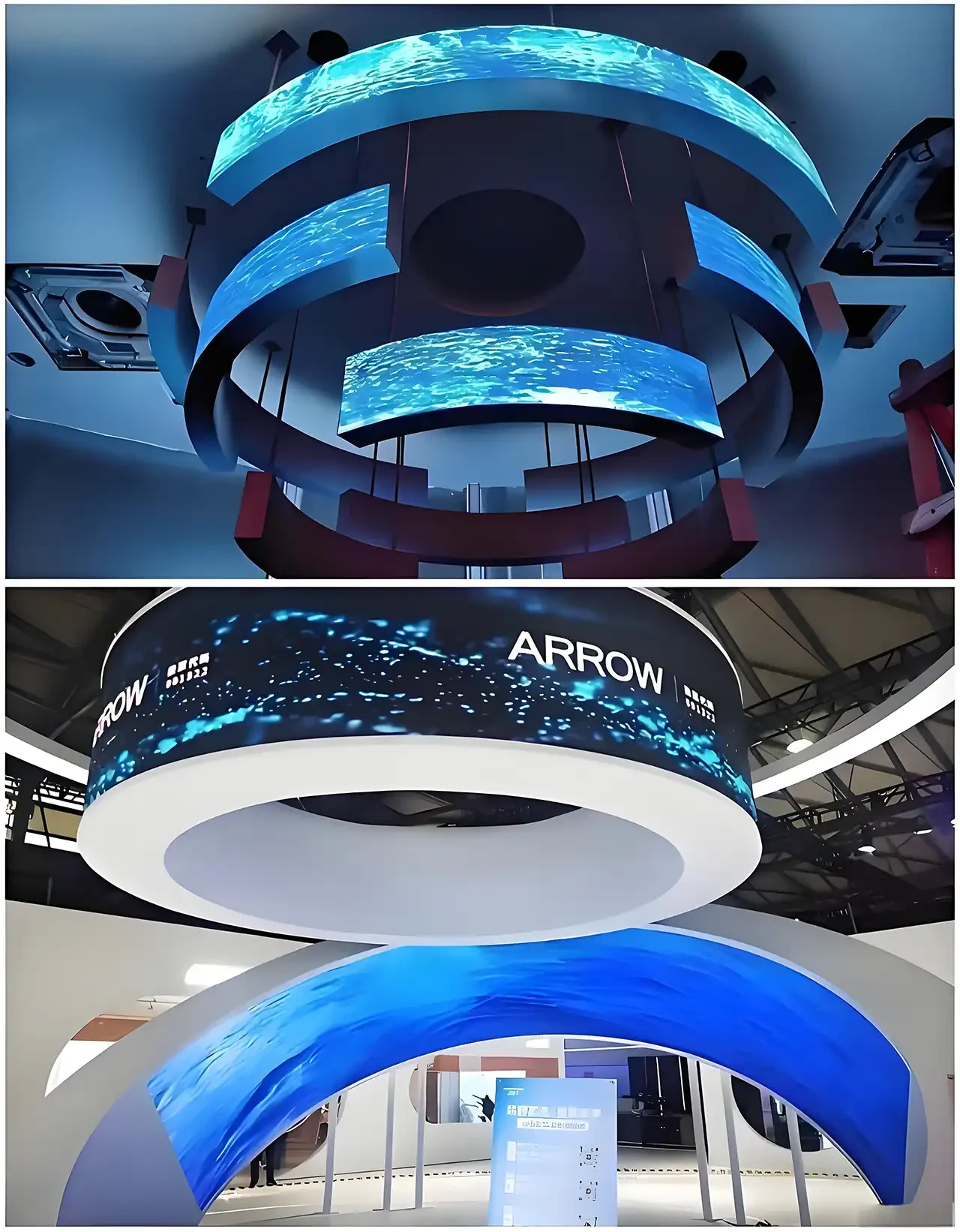
A curved LED screen is a digital display system that forms a concave, convex, cylindrical, or free-form surface rather than a flat plane. Instead of relying on a single rigid panel, these displays are constructed from modular LED units that can be adjusted at precise angles to create smooth curves.
Unlike curved LCD or OLED panels, which are manufactured as fixed curved sheets, LED screens achieve curvature through structural flexibility and modular alignment, not through bending a single panel.
Key characteristics include:
Modular LED cabinets or flexible LED modules
Adjustable mounting angles
Seamless visual continuity across curved surfaces
Consistent brightness and color uniformity
This design approach allows curved LED screens to be scaled from small indoor installations to massive outdoor facades.
How LED Screens Achieve Curvature
LED screens are made up of thousands—or even millions—of individual light-emitting diodes mounted on circuit boards. These boards are assembled into modules, which are then mounted onto cabinets or frames.
Curvature is achieved in several ways:
Modular Angle Adjustment
Standard LED cabinets can be connected at slight angles, forming a polygonal curve that appears smooth when viewed from normal distances. This method is commonly used for large curved video walls.
Flexible LED Modules
Flexible LED screens use soft PCB materials and rubberized housings, allowing modules to bend horizontally or vertically. These are often used for creative installations, columns, waves, and irregular surfaces.
Custom Structural Frames
A precisely engineered steel or aluminum frame determines the curvature radius. The LED modules are mounted onto this structure, ensuring accuracy and stability.
The curvature itself is not created by bending the LEDs, but by engineering the support system that holds them.
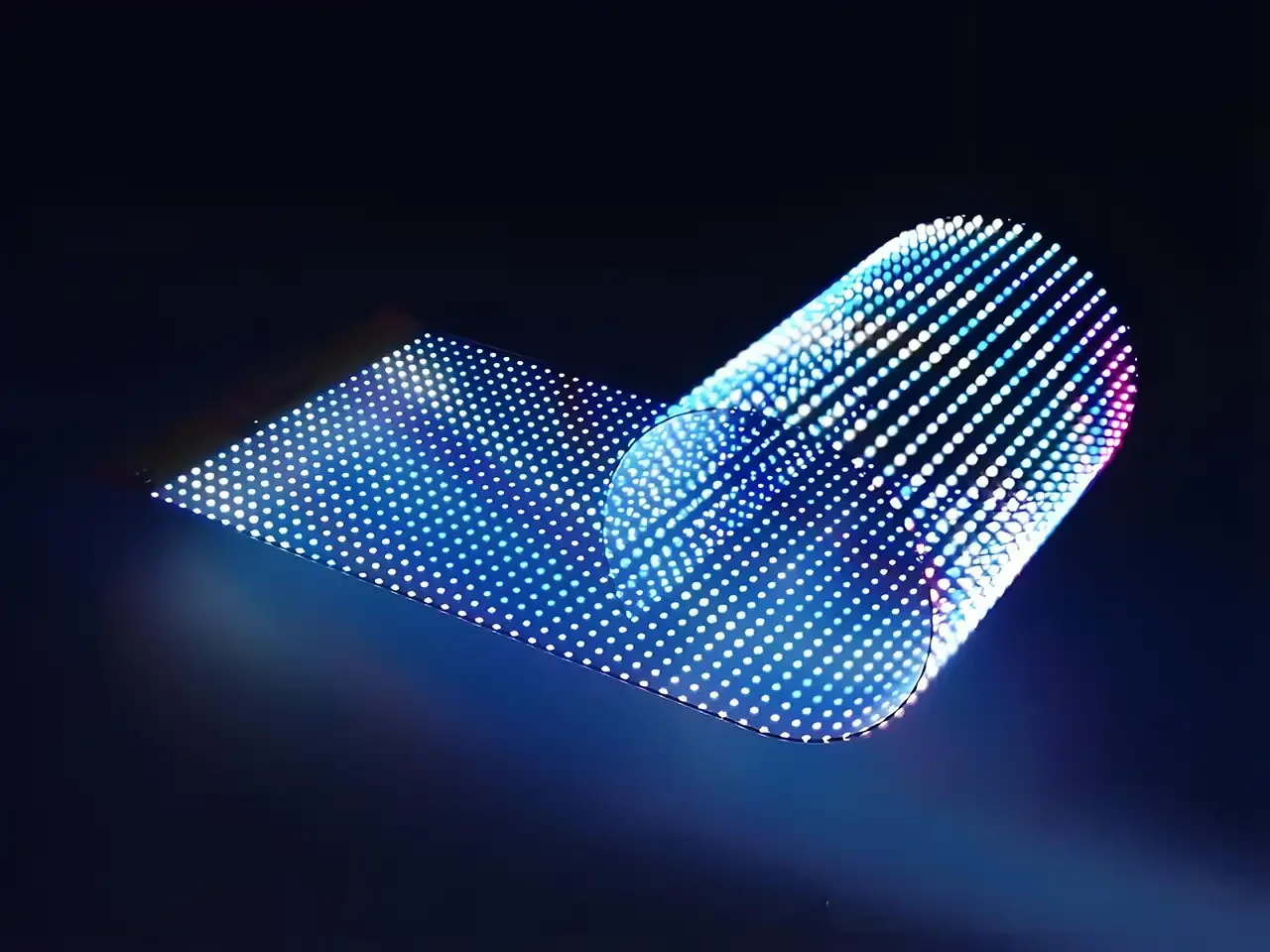
Types of Curved LED Screens
Curved LED displays can be categorized based on shape, structure, and application.
Concave LED Displays
Concave screens curve inward toward the viewer. They are commonly used in control rooms, simulation environments, and immersive advertising displays.
Advantages include:
Enhanced immersion
Reduced viewing distortion
Improved focus on central content
Convex LED Displays
Convex screens curve outward and are often used for building corners, cylindrical columns, and landmark advertising.
Benefits include:
Wide viewing angles
High visual impact from multiple directions
Strong architectural integration
Cylindrical LED Screens
These displays wrap fully or partially around columns or pillars. They are popular in shopping malls, airports, and exhibition halls.
Free-Form and Irregular LED Displays
Advanced flexible LED technology allows for wave shapes, spiral forms, and organic designs. These are often custom-engineered for brand flagships or public art installations.
Can Outdoor LED Screens Be Curved?
Outdoor LED screens can absolutely be curved, and they are increasingly common in urban advertising and architectural media.
Outdoor curved LED displays are designed to withstand:
Rain, humidity, and dust
UV exposure and direct sunlight
Temperature fluctuations
Wind loads on curved surfaces
To ensure performance and safety, outdoor curved LED screens typically use:
High-brightness LEDs for daylight visibility
Waterproof modules and sealed cabinets
Reinforced mounting frames
Corrosion-resistant materials
Curved outdoor LED billboards are frequently installed on building corners, stadium facades, and roadside landmarks, where flat screens would appear visually disconnected from the surrounding architecture.
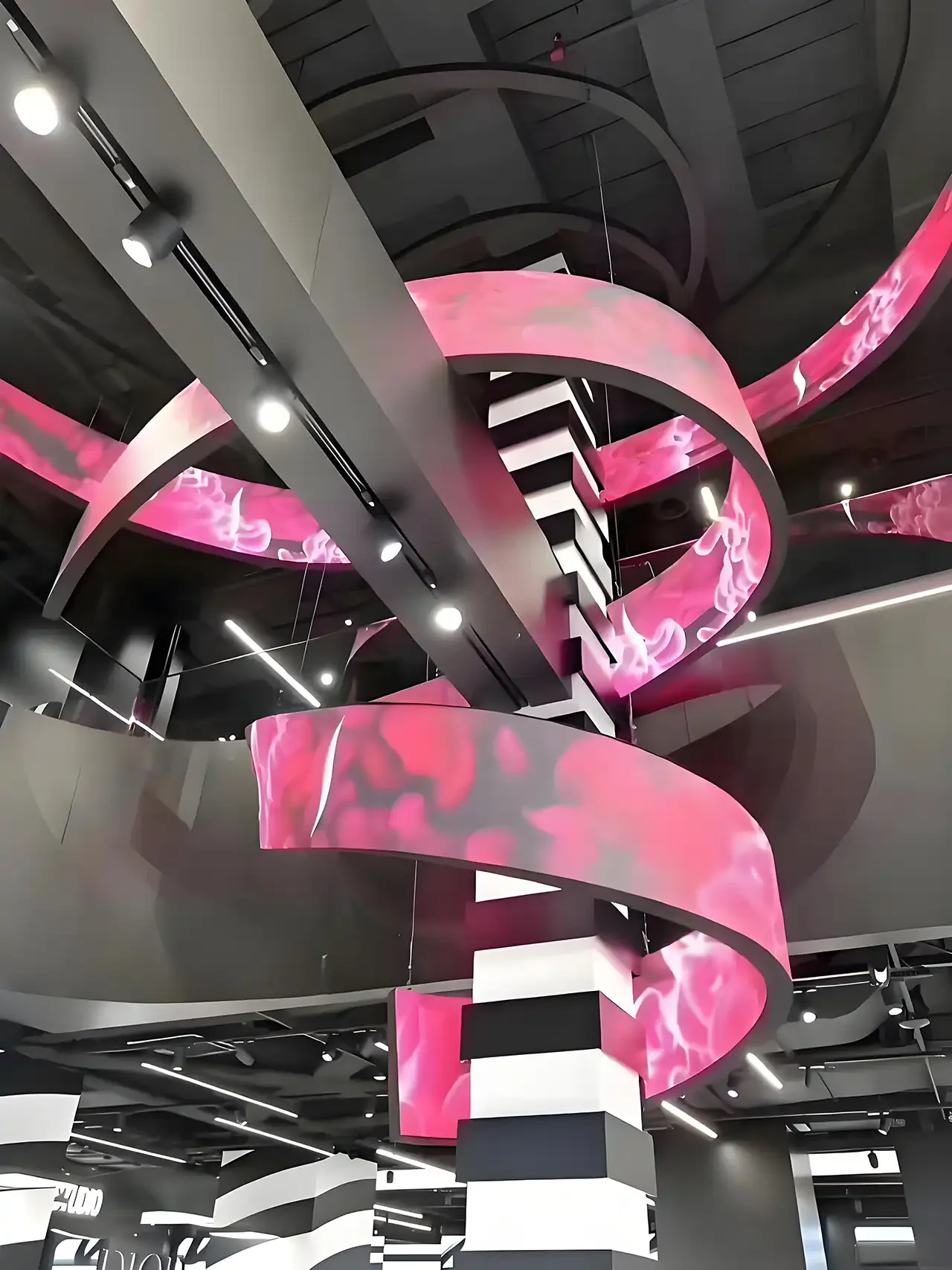
Visual Advantages of Curved LED Screens
Curved LED screens offer several perceptual and experiential benefits over flat displays.
Enhanced Immersion
A curved surface naturally follows the viewer’s field of vision, creating a more immersive visual experience, especially for large-format displays.
Reduced Viewing Angle Distortion
Curvature helps maintain consistent brightness and color accuracy across wide viewing angles, particularly in concave configurations.
Stronger Visual Impact
Curved displays stand out in crowded environments, attracting attention through shape alone—even before content is considered.
Architectural Harmony
Curved LED screens integrate more naturally with modern architecture, avoiding the “add-on” appearance of flat panels.
Technical Considerations for Curved LED Screens
Designing a curved LED screen involves more than selecting flexible modules.
Pixel Pitch Consistency
Maintaining uniform pixel pitch across curved surfaces is critical for image clarity. Poor alignment can cause visual distortion.
Structural Precision
Even minor deviations in cabinet angles can result in visible seams or brightness inconsistencies.
Heat Dissipation
Curved designs may alter airflow patterns. Proper thermal management ensures long-term stability and LED lifespan.
Signal Calibration
Curved LED displays require advanced calibration to ensure color, brightness, and grayscale consistency across all modules.
Indoor vs Outdoor Curved LED Screens
While the basic concept remains the same, indoor and outdoor curved LED screens differ significantly in design priorities.
Indoor curved LED displays focus on:
Fine pixel pitch
Close viewing distances
Color accuracy
Lightweight structures
Outdoor curved LED displays prioritize:
High brightness
Weather resistance
Structural strength
Long-distance visibility
The intended environment determines the module type, cabinet design, and installation method.
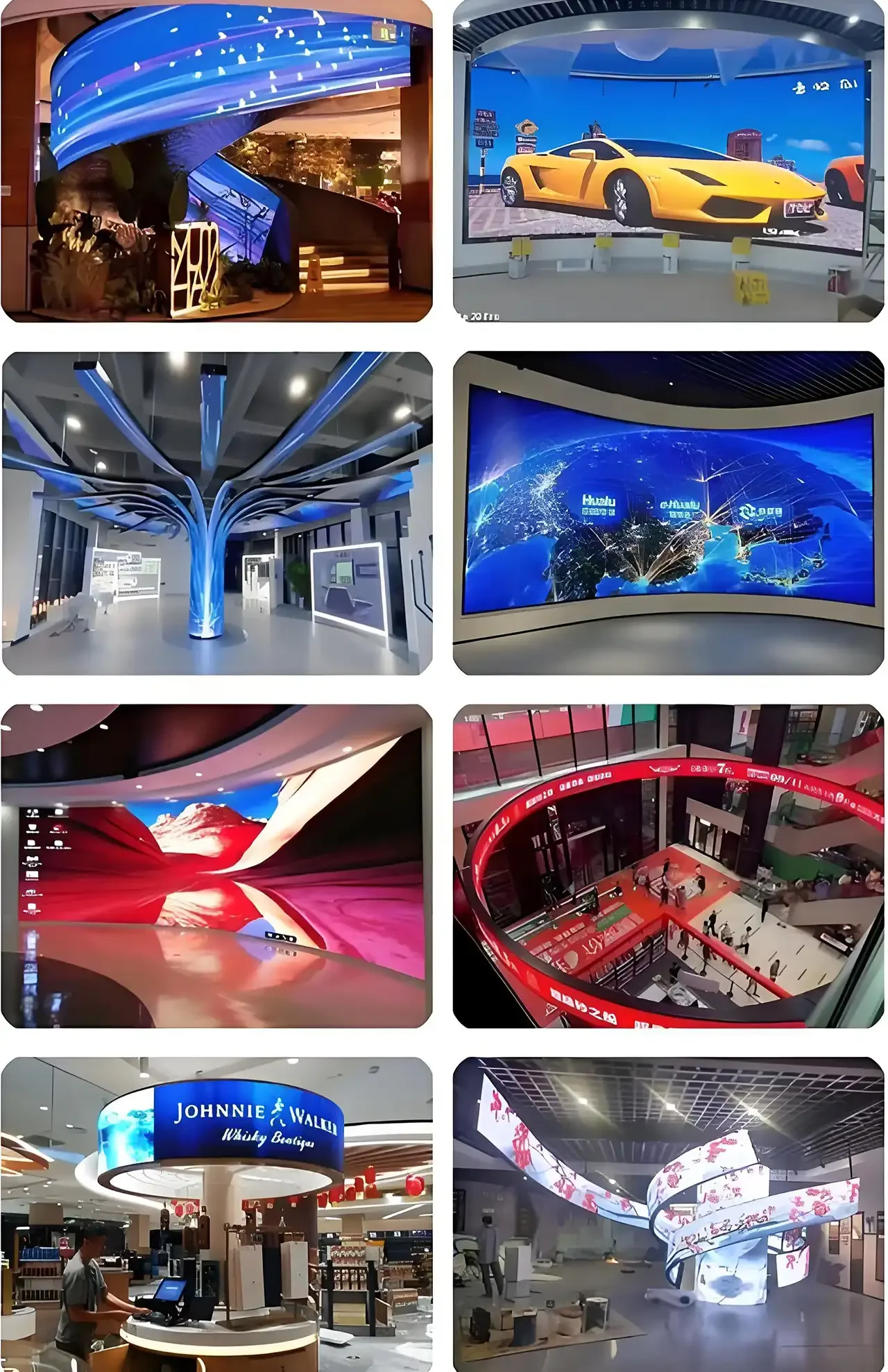
Common Applications of Curved LED Screens
Curved LED technology has found adoption across many industries.
Retail and Brand Spaces
Curved LED walls create immersive brand storytelling environments and premium shopping experiences.
Advertising and Media
Outdoor curved LED billboards increase visibility at intersections and building corners.
Entertainment and Events
Concert stages, theaters, and exhibitions use curved LED backdrops for dynamic visual effects.
Transportation Hubs
Airports and train stations employ curved LED displays for wayfinding and large-scale information delivery.
Corporate and Control Rooms
Concave LED screens improve visibility and focus in monitoring environments.
Installation Challenges and Solutions
Curved LED screen installation requires precise planning.
Challenges include:
Accurate curvature calculation
Structural load distribution
Cable routing on curved surfaces
Maintenance access
Solutions involve:
Pre-engineered mounting systems
Detailed 3D modeling
Modular access panels
Front or rear service designs
Professional installation ensures both visual quality and long-term safety.
Content Design for Curved LED Screens
Curved screens influence how content is perceived.
Effective content strategies consider:
Viewer movement and distance
Natural focal points created by curvature
Avoiding edge distortion
Utilizing panoramic visuals
Content optimized for curved LED displays often feels more cinematic and engaging than flat-screen content.
Durability and Lifespan of Curved LED Displays
Curvature does not reduce durability when engineering standards are met.
High-quality curved LED screens offer:
Long operational lifespans
Stable brightness over time
Consistent color performance
Reliable operation in continuous-use environments
Routine maintenance and proper installation play a key role in longevity.
Cost Factors of Curved LED Screens
Curved LED screens generally cost more than flat displays due to:
Custom structural design
Specialized modules or cabinets
Increased engineering complexity
Installation precision
However, the added visual impact and architectural integration often justify the investment, particularly for high-visibility locations.
Scalability and Customization
One of the strongest advantages of curved LED technology is scalability.
Displays can be:
Expanded horizontally or vertically
Adjusted to different curvature radii
Integrated with flat LED sections
Customized for unique architectural layouts
This flexibility makes curved LED screens suitable for both temporary and permanent installations.
Future Trends in Curved LED Technology
Advancements continue to expand design possibilities.
Emerging trends include:
Ultra-flexible micro-LED modules
Higher resolution curved outdoor displays
Lighter structural materials
Seamless integration with smart building systems
As technology evolves, curved LED screens are expected to become more accessible and more visually refined.
Frequently Asked Questions
Are curved LED screens more fragile than flat ones?
Curved LED screens are not inherently more fragile. Durability depends on module quality, structural design, and installation standards rather than screen shape.
Can a curved LED screen be repaired easily?
Most curved LED displays use modular designs, allowing individual modules to be replaced without dismantling the entire screen.
Do curved LED screens consume more power?
Power consumption is determined by brightness, pixel density, and operating time. Curvature itself does not significantly increase energy usage.
Is special content required for curved LED screens?
Standard content can be displayed, but visuals designed for curved formats often deliver better immersion and balance across the screen.
Can curved LED screens support touch interaction?
Touch functionality can be integrated into certain indoor curved LED displays, depending on module design and application requirements.
Are curved LED screens suitable for long-term outdoor use?
When designed with weatherproof materials and proper structural support, curved LED screens perform reliably in outdoor environments for many years.
Conclusion
A LED screen can be curved, and that capability has transformed how digital displays interact with architecture, audiences, and environments. Through modular engineering, flexible materials, and precise structural design, curved LED screens deliver immersive visuals that flat displays cannot replicate. Whether used indoors or outdoors, their adaptability, durability, and visual strength make them a defining feature of modern display technology—where form and function move together in a seamless visual experience