

























TV Broadcast Studios LED Screen
Professional LED Display Solutions for European & American TV Broadcast Studios
In the era of high-definition and immersive storytelling, TV broadcast studios across Europe and North America are accelerating their transition to LED display technology.
From 24-hour news channels to virtual production sets, modern broadcasters demand visual systems that combine reliability, color precision, and instant adaptability.
Our LED studio display solutions are engineered for the stringent requirements of broadcast environments—ensuring flawless on-camera performance, stable 24/7 operation, and flexible integration with today’s broadcast control ecosystems.
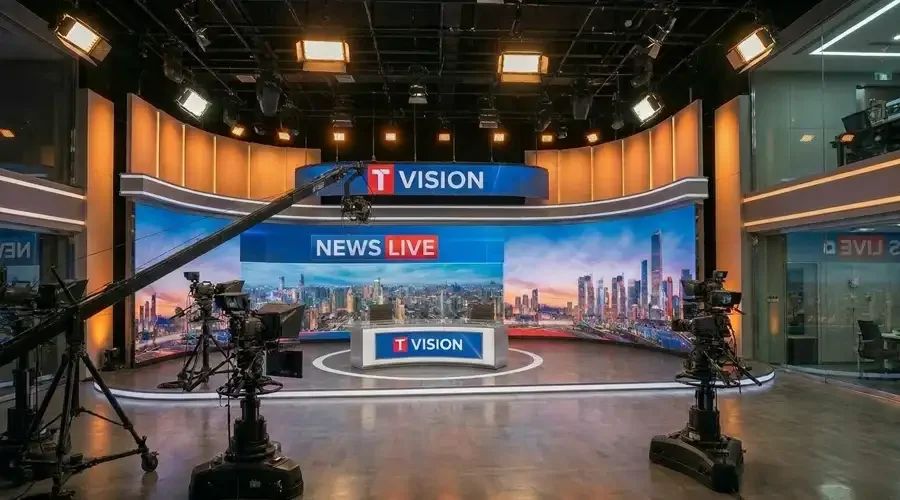
Broadcast-Level LED Display Architecture
A complete TV studio LED system typically includes:
Fine-Pitch LED Video Wall Modules (e.g., P0.9 / P1.2 / P1.5)
Video Processor & Sender Units (NovaStar, Brompton, or Colorlight)
Color and Camera Synchronization Interface (Genlock / 3G-SDI / HDMI / DisplayPort)
Media Playback & Scene Management System (e.g., Vizrt, Ross Video, Unreal Engine, Disguise)
Power & Signal Redundancy Network
Structural Integration (Curved wall, floor integration, side wings, or ceiling halo)
All systems are optimized for flicker-free imaging when captured by broadcast cameras operating at variable shutter speeds or frame rates (24–120Hz).
Fine-Pitch LED Display Technology
| Series | Pixel Pitch | Brightness | Refresh Rate | Color Depth | Suitable For |
|---|---|---|---|---|---|
| FD Pro | P1.2–P1.9 | 600–1200 nits | 3840–7680Hz | 16-bit | News studios, financial channels |
| XR Vision | P1.9–P2.6 | 1000–1500 nits | 7680Hz | 18-bit HDR10+ | Virtual production & AR sets |
| ControlView | P1.5–P2.5 | 700–1000 nits | 3840Hz | 14-bit | Monitoring & control rooms |
| FloorSense | P2.9–P3.9 | 1200 nits | 3840Hz | 16-bit | Interactive stage floors |
LED characteristics such as low pixel pitch, high contrast ratio (≥10,000:1), and calibrated gamma curves ensure accurate reproduction of skin tones and studio graphics.
Each panel undergoes camera-based color calibration, verified with vectorscope instruments to achieve full compliance with Rec.709 and DCI-P3 color spaces.
Integration with Broadcast & Virtual Production Workflows
Modern television production often blends physical and virtual environments.
Our system integration supports a range of virtual production and XR setups:
✅ Unreal Engine / Disguise XR Workflow – real-time 3D virtual camera tracking and background rendering.
✅ Mo-Sys / Stype / NCAM Protocols – for accurate camera position data sync.
✅ Dynamic Genlock – synchronizes LED output refresh with camera shutter to eliminate moiré.
✅ Low Latency (≤2 frames) – essential for live switching and real-time broadcast.
✅ Multi-Layer Compositing – combine live camera feeds, dynamic lower-thirds, and animated textures.
This achieves seamless integration between real presenters and digital environments, enabling immersive storytelling both in live news and entertainment productions.
Studio Design Flexibility
LED video walls can be customized to match architectural layouts:
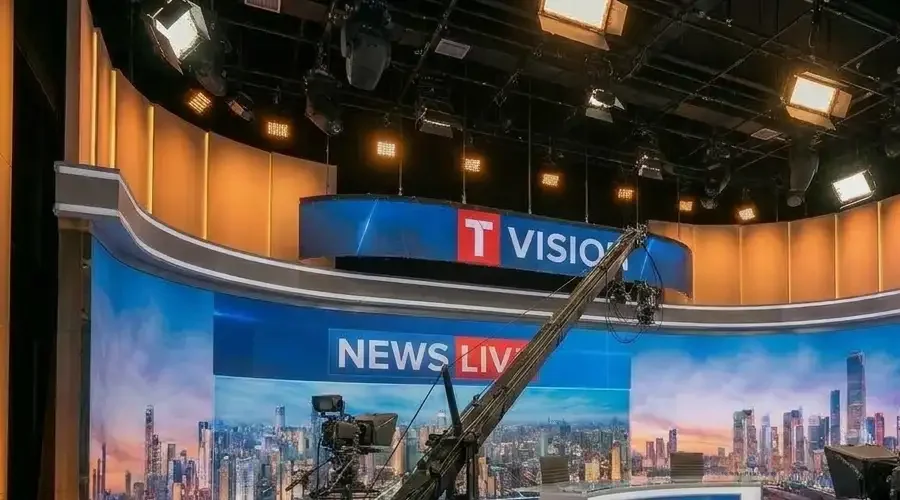
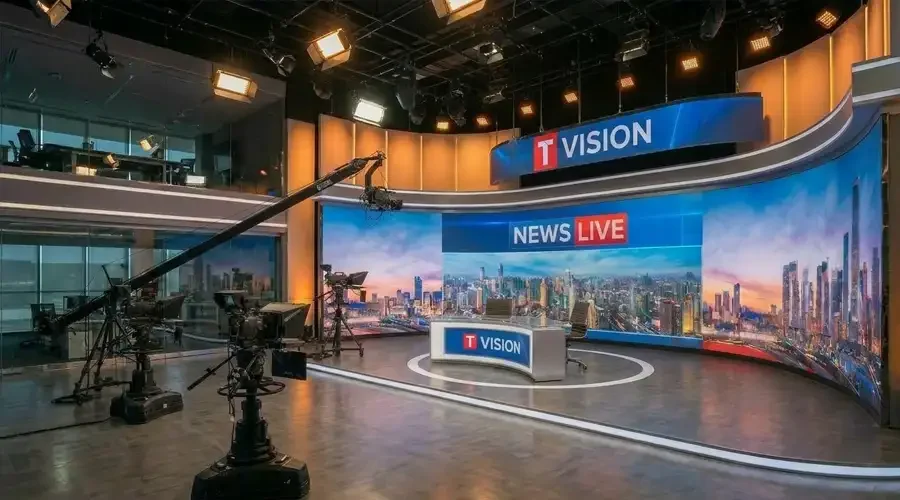
Curved Backdrops: 180° or 220° wrap-around layouts enhance camera depth and scenic control.
Segmented Modular Panels: allow resizing for talk-show desks, sports corners, or infotainment zones.
Ceiling and Side-Wing Integration: continuous light animation to define spatial boundaries.
Interactive Floor Displays: synchronized stage lighting and motion sensors for dynamic performances.
Our engineering team provides 3D visualization and layout simulation before installation, ensuring precise camera angles, light reflection control, and ergonomic positioning for each anchor seat.
Control System and Redundancy
For 24/7 studios, system reliability is non-negotiable. Our design includes:
N+1 Power & Data Redundancy: auto-switching safeguards against single-point failures.
Dual Signal Path Transmission (Primary/Backup): ensures uninterrupted on-air performance.
Real-Time Monitoring Software: tracks LED temperature, voltage, and pixel health.
Remote Diagnostics: allows technicians to identify failing modules before broadcast hours.
Integration with broadcast automation (such as Ross Overdrive or Viz Mosart) ensures LED background changes are synchronized with scripts and timeline commands automatically.
Color, Brightness, and Calibration Management
Each studio LED solution includes:
16-bit grayscale depth for smooth gradient transitions under camera capture.
Auto Color Uniformity System maintaining consistent tone under mixed lighting conditions.
Pre-Calibrated Brightness Mapping between multiple displays (main wall + side monitors).
3D LUT Color Management for consistent reproduction across different camera brands (Sony, Grass Valley, Blackmagic).
When studios use HDR or wide-gamut production pipelines, the display system is tuned to HDR10 or PQ gamma to deliver punchy highlights without overexposure.
Maintenance and Long-Term Operation
Tool-free front maintenance for fast module replacement.
Fanless cabinet options to reduce ambient noise in live sound environments.
Average lifespan: ≥100,000 hours under studio brightness levels.
Optional pixel-level repair mode with hot-swap module capability.
Support for IP5X dust protection to maintain image uniformity in long-term usage.
All systems comply with European CE-LVD and North American UL standards.
Case Study: Broadcasting Network in Germany
Project Scope:
Main news studio (15m × 2.8m curved LED wall)
Secondary discussion zone (4m flat LED screen)
Monitoring control center displays
Technical Highlights:
Pixel pitch: P1.5 Fine Pitch Series
Controller: NovaStar MCTRL4K + redundant sender setup
Integrated broadcast router: Ross Ultrix
Power redundancy: Dual UPS and PDU backup
Outcome:
The LED solution replaced 9 LCD video walls, increased color accuracy by 42%, and reduced overall system heat output by 33%.
Producers now create custom themed sets for election coverage, weather analysis, and sports highlights—all through a digital interface, without rebuilding physical sets.
Future Outlook
LED technology continues to evolve toward MicroLED and COB encapsulation, further reducing moiré and reflection issues for ultra-close shooting.
As 8K broadcasting and immersive XR content become mainstream, LED systems will play a central role in connecting content design, cinematography, and real-time data visualization.
For broadcasters in Europe and North America, adopting professional LED systems is no longer about visual decoration—it’s about operational agility, storytelling flexibility, and brand credibility on a global scale.
Micro LED Screen Products
-
 P0.78 COB Fine Pitch LED Screen | Indoor Video Wall
The P0.78 LED screen features an ultra-fine 0.78mm COB pixel pitch, delivering razor-sharp clarity and vivid color even ...
-
 P0.9375 Micro led screen indoor
P0.9375 Micro LED Screen Indoor delivers ultra-high resolution, seamless splicing, vivid color, and close-view image cla...
-
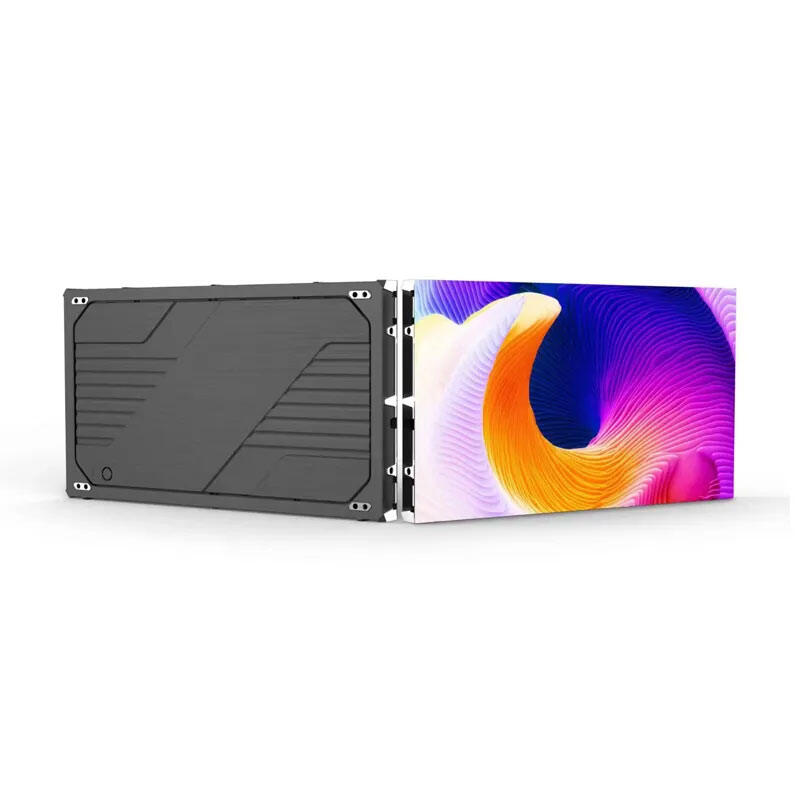 P1.25 Ultra-fine pitch indoor led screen
P1.25 ultra-fine pitch indoor LED screen with 600×337.5mm 16:9 cabinet, high refresh rate, front service & HD clarit...