



































P0.9 Fine Pitch MIP LED Display for Home Theater | Reiss Optoelectronics
P0.9 MIP LED: Redefining the Private Cinema Experience
The home theater market has entered a new era. Where projection systems and large-format LCD screens once defined the premium residential viewing experience, today's most discerning homeowners and interior designers are turning to Fine Pitch MIP LED technology — and for good reason. The clarity, contrast, color depth, and immersive scale that a P0.9 MIP LED display delivers in a private home environment is simply beyond what any projection or LCD solution can match.
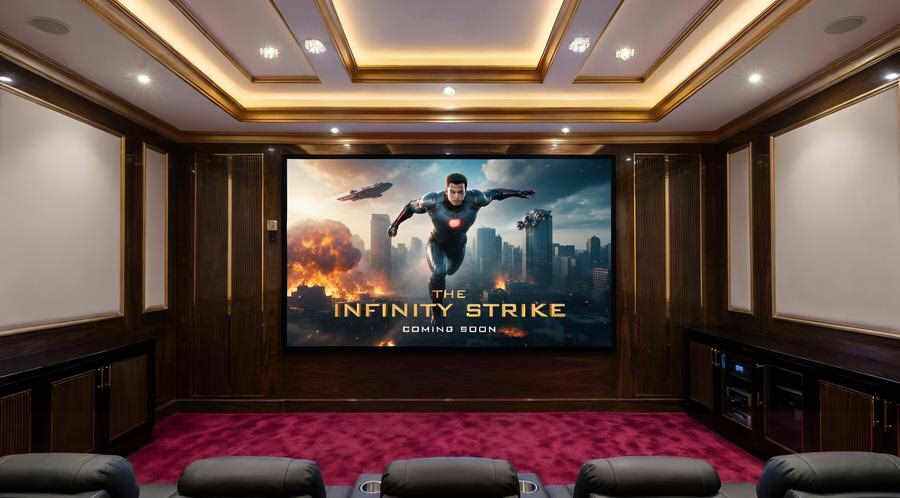
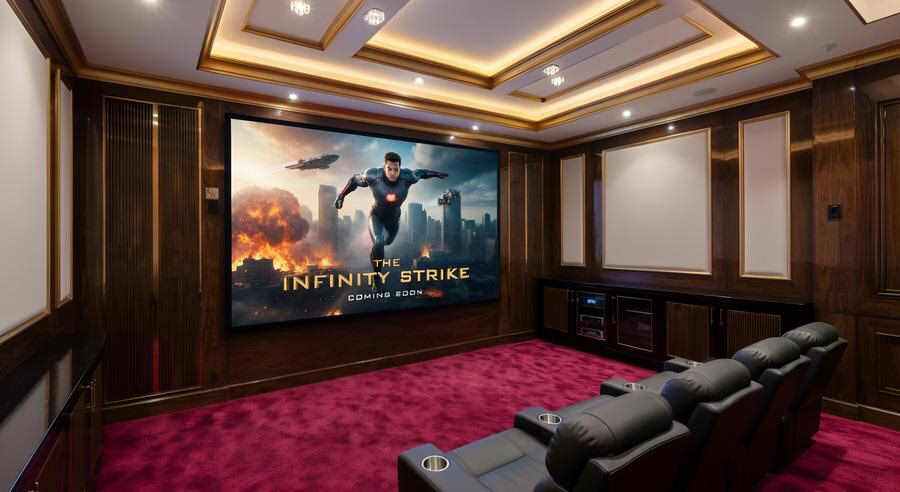
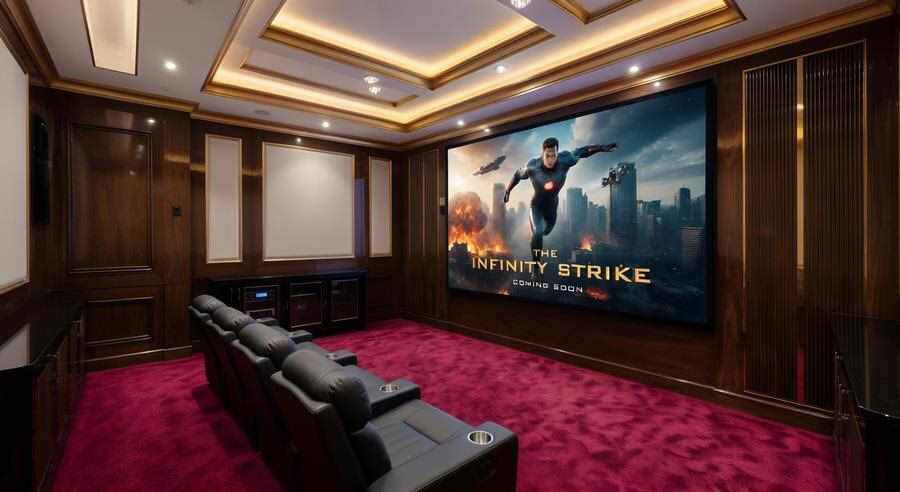
This case study uses a 16:9 aspect ratio and measures 3.6 x 2.025 meters. It details how Rise Optoelectronics designed and delivered a P0.9 Fine Pitch MIP LED home theater display system to a US customer—covering the technology behind the solution, the installation process, and the visual effects achieved by the end-user.
What Is MIP LED Technology and Why Does It Matter for Home Theater?
MIP — Micro LED in Package — represents one of the most significant advances in fine pitch LED display manufacturing. Unlike conventional LED displays, MIP technology integrates microscopic LED chips directly at the package level, resulting in dramatically smaller pixel structures, higher consistency across the display surface, and significantly improved resistance to physical damage during handling and installation.
For home theater applications, MIP technology delivers three critical advantages over standard fine pitch LED. First, color uniformity across the entire display surface is exceptional — there are no visible brightness or color variations between panels, which is essential for an immersive cinematic viewing experience. Second, the contrast performance of MIP LED far exceeds that of projection, as each pixel produces its own light and can be independently controlled — delivering true deep blacks and brilliant highlights simultaneously on screen. Third, MIP displays are highly resistant to pixel damage during the installation process, making them well-suited to the careful, high-care environments typical of premium residential projects.
At P0.9 pixel pitch, the display achieves a pixel density sufficient for full 4K resolution at typical home theater viewing distances, with no visible pixel structure and no loss of image detail at any point in the room.
Project Overview: A Premium Residential Home Theater Installation
The client for this project was a high-end residential homeowner seeking to build a dedicated private cinema room as part of a luxury home renovation. The brief was clear: the display needed to deliver a true cinematic experience at the level of a professional screening room — with no image quality compromises, no visible seams, and a design that integrated cleanly with the room's architectural interior.
After evaluating projection-based systems and high-end LCD configurations, the client's interior design team and AV consultant determined that a Fine Pitch MIP LED display was the only solution capable of meeting the visual performance brief while also satisfying the room's specific dimensional and lighting requirements.
Reiss Optoelectronics was selected as the manufacturing and supply partner based on its MIP LED product capability, customization flexibility, and technical support offering.
The Solution: P0.9 MIP LED Display System — Technical Specifications and Design
The Reiss engineering team worked closely with the client's AV consultant and interior architect from the earliest stage of the project, developing a display configuration that met the room's dimensional layout, seating arrangement, and ambient lighting conditions.
Ultra-Fine P0.9 Pixel Pitch — True 4K Clarity in a Home Environment
At 0.9mm pixel pitch, the display achieves the pixel density required to render 4K content at full resolution without any visible pixelation at the primary viewing distance established for the room. Close-range detail — facial textures, fine text, intricate visual effects — is reproduced with a level of sharpness and depth that projection systems fundamentally cannot match, due to their inherent dependence on lens focus, screen material reflectivity, and ambient light management.
MIP Technology — Consistent Brightness and Color Across the Full Screen
MIP construction ensures that every point across the display surface maintains consistent brightness output and color accuracy — a critical requirement for cinema viewing, where even minor variations in uniformity become visible during dark-scene content. Factory-level color calibration was applied across all panels prior to shipment, ensuring a matched visual output from edge to edge and corner to corner of the installed display.
HDR 10 — Deep Contrast and Wide Color Gamut for Cinematic Content
The display system supports HDR 10, enabling wide color gamut reproduction and deep contrast performance that brings cinematic content to life at near-mastering quality. Highlights remain brilliant while shadow detail is preserved — creating the full dynamic range that modern 4K HDR content is produced to deliver. For a client watching premium streaming content, Blu-ray, or proprietary cinema files in a dedicated room, HDR 10 performance is not optional — it is the baseline for an authentic cinematic experience.
High Contrast Ratio — True Black Performance Without Ambient Light Compromise
Unlike projection systems, which depend on room darkness to achieve acceptable contrast, MIP LED displays produce each pixel's light independently — meaning that deep blacks and brilliant whites can coexist on screen at the same moment without interference. This self-emissive characteristic allows the display to maintain cinematic contrast performance even in rooms with some residual ambient lighting, giving homeowners significantly more flexibility in their room design and usage.
Seamless Panel Integration — One Uninterrupted Screen Surface
Multiple MIP LED panels were precisely joined to create the full screen size required by the installation. With near-invisible cabinet seams, the finished display presents as a single continuous image surface — with no grid lines, no panel borders, and no visual interruption of any kind. From the primary seating position, the display reads as one seamless cinematic canvas.
Installation Process: Precision Integration Into a Luxury Interior
Home theater installations differ meaningfully from commercial event or corporate environments. The installation space is a finished, high-value interior — requiring careful handling, precise structural integration, and a clean, architecturally resolved result.
The Reiss technical installation team coordinated directly with the client's interior contractor to plan the structural mounting framework, cable management routing, and panel assembly sequence in advance of arrival on-site. All work was carried out with full protection of the surrounding finished surfaces.
Following panel installation and structural integration, the technical team conducted a comprehensive commissioning process — including full-surface brightness uniformity verification, color temperature calibration across all panels, HDR processing configuration, and system integration with the room's AV control platform. Every parameter was confirmed against the client's visual specification before the installation was signed off.
Results: A Private Cinema Experience at the Highest Level
Upon completion, the installed P0.9 MIP LED display delivered precisely the visual experience the client had briefed. 4K HDR content — whether streamed, played via disc, or accessed from local media — was reproduced at a level of clarity, color depth, and dynamic range that exceeded the client's expectations and those of the AV consultant overseeing the project.
The seamless display surface, combined with the room's acoustic treatment and seating design, created a private cinema environment with a genuine professional screening room quality. The absence of any projection-related limitations — light spill, focus management, lamp replacement, or screen surface dependency — delivered a viewing experience that required no compromise and no management by the end user.
Why P0.9 MIP LED Is the Right Choice for a Premium Home Theater
For homeowners and AV professionals evaluating display options for a serious home cinema installation, the case for P0.9 MIP LED over projection and LCD is increasingly clear.
Projection systems, regardless of their specification level, introduce inherent variables — lens focus, screen material, ambient light sensitivity, and lamp or laser maintenance — that require ongoing management and impose limitations on room design flexibility. High-end LCD panels, while capable of excellent image quality, retain physical bezels that interrupt the display surface and cannot be scaled beyond fixed panel sizes. Neither technology offers the combination of seamless scale, self-emissive contrast performance, pixel-level color control, and design flexibility that Fine Pitch MIP LED provides.
At P0.9 pixel pitch, MIP LED brings professional display technology into the home theater environment at a resolution and quality level that genuinely meets the standard of dedicated commercial screening rooms — making it the definitive choice for homeowners who require the highest level of cinematic performance.
Frequently Asked Questions: P0.9 MIP LED Home Theater Displays
What screen size can be achieved with a P0.9 MIP LED display?
MIP LED displays are fully modular and can be configured to virtually any screen size. For home theater applications, typical installations range from 110 inches to over 200 inches, depending on room dimensions and seating distance.
Is a P0.9 MIP LED display suitable for a room with some ambient light?
Yes. Unlike projection systems, MIP LED displays are self-emissive — each pixel generates its own light independently. This means the display maintains strong contrast and color performance even in rooms with controlled ambient lighting, offering homeowners significantly more design flexibility than projection-based systems.
How does a P0.9 MIP LED display compare to a laser projector for home theater?
A P0.9 MIP LED display delivers superior contrast, no screen surface dependency, no lens focus management, full 4K HDR performance, and a seamless display surface without any physical frame. For a dedicated home theater environment, MIP LED provides a more consistent, higher-fidelity visual experience with no ongoing lamp or laser maintenance requirements.
What is the lifespan of a MIP LED home theater display?
High-quality MIP LED displays achieve a rated lifespan of 100,000 hours or more under normal operating conditions — far exceeding the service life of projection lamp or laser systems and requiring no source replacement over the display's operational lifetime.
Can a P0.9 MIP LED display be integrated with existing home automation and AV control systems?
Yes. Reiss MIP LED display systems are compatible with standard AV control platforms and can be fully integrated into existing home automation environments, including control via dedicated AV processors, smart home systems, and custom interface configurations.
Deliver the Ultimate Home Theater Experience with Reiss Optoelectronics
Reiss Optoelectronics has been designing and manufacturing professional LED display solutions since 2004. With full in-house MIP LED production capability, factory-level color calibration, and a dedicated technical support team experienced in premium residential and commercial installations, Reiss is the manufacturing partner of choice for homeowners, AV integrators, and interior architects seeking the highest standard of Fine Pitch LED display performance.